

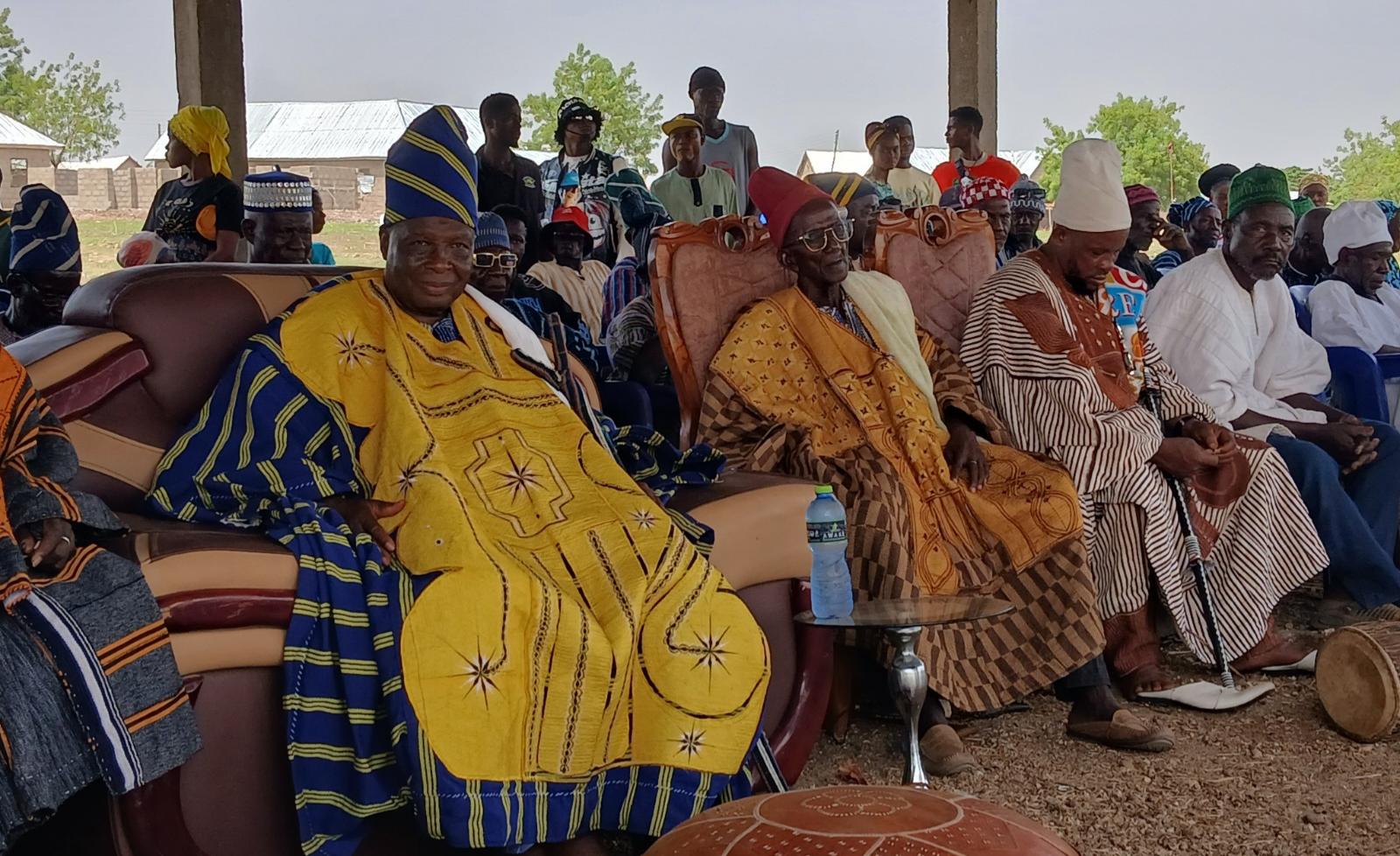
The Bawiesibai Development Association (BDA) has successfully revived its annual durbar after several years of inactivity, bringing together traditional leaders, elders, youth, women, association members, stakeholders and well-wishers to deliberate on the development and future of the Bawiesibai community and Traditional Area.
The durbar, held on Saturday, 4 April 2026, was organized under the theme: “Building Our Community Together: The Role of Chiefs, Youth and Stakeholders.”
The gathering was attended by the Paramount Chief of the Bawiesibai Traditional Area, Kuoro Alhaji Abdul-Salame Akate Balugubanie II, elders of the Traditional Area, members of the Association from within and outside the Upper West Region, as well as a large number of community members.
The event provided a platform for stakeholders to reflect on challenges confronting the community and explore ways of strengthening unity and accelerating development.
The Assemblyman for the Bawiesibai Electoral Area, Hon. Yakubu N. Saani, who delivered an address on behalf of the Traditional Council, express hope that the initiative would continue in subsequent years and thanked the organizers for bringing members of the community together.
The Traditional Council highlighted several issues requiring collective attention, including chieftaincy disputes and other developmental challenges confronting the Traditional Area.
Addressing the Nabulo chieftaincy matter, Hon. Saani stressed that peace and unity are essential to winning the fight against poverty.
He noted that the Nabulo chieftaincy matter had taken a legal dimension and appealed to the Bawiesibai Development Association to support the Traditional Council in its efforts to resolve the matter.
The Assemblyman also recalled the Paramount Chief’s observation that conflicts in the modern era should be resolved through lawful and peaceful means rather than through traditional weapons and violence.
Hon. Saani further noted that the Komo chieftaincy issue, which had previously been a major source of tension, had been resolved through the intervention of the Paramount Chief.
He announced that Bayorborbai, formerly under Bawiesibai, had now formally become part of the Bawiesibai Traditional Council.
He therefore called on the BDA to work closely with the Traditional Council to support the development agenda of the Traditional Area.
Addressing the gathering, the President of the Bawiesibai Development Association, Mr. Nuhu Mustapha, described the occasion as a time for reflection, reconnection and renewal.
He acknowledged the contributions of past leaders who had worked to keep the Association alive and appealed to chiefs, elders and all members of the community to give the current executive their full support.
According to him, the Association had been unable to organise its annual homecoming since 2018, a period he said had weakened community engagement, reduced communication and slowed development.
He stressed that when people stop coming together, relationships and community bonds gradually weaken. He therefore described the gathering as an opportunity to break the silence and give the Association a fresh start.
The President mentioned that Bawiesibai belongs to everyone, and that its development must therefore be a shared responsibility.
He called on members to reject division and consciously promote unity. He outlined several priorities of the new leadership, including: Reviving regular community engagement, strengthening unity among community members, Encouraging youth participation and leadership, Promoting education and development, and Initiating sustainable development projects.
He appealed particularly to members living outside Bawiesibai to continue contributing to the development of the community, stressing that physical distance should not mean distance from their responsibilities.
The Paramount Chief of the Bawiesibai Traditional Area and President of the Traditional Council, Kuoro Alhaji Abdul Salam Akate Sapara Balugubani II expressed his appreciation for the gathering and gave a brief history of the Development Association.
He explained that the Association began as a student union before expanding its membership and activities to become the organisation it is today.
According to him, the Association has contributed significantly to the development of the traditional community and played an important role in the emergence of the current Bawiesibai chieftaincy institution.
The Paramount Chief attributed part of the Association’s period of inactivity to the COVID-19 pandemic, describing the current gathering as a rebirth of the Association.
He explained that participation in this year’s event was deliberately limited to members and stakeholders as the Association worked to rebuild itself.
He further described the Association as a strong pillar of the community, stressing that, just as a building needs strong pillars to stand, the Traditional Area needs a strong and united development association.
He appealed to members living in different parts of the country and beyond to make greater efforts to participate in the affairs of the Association.
The Paramount Chief also expressed concern about development projects initiated by the Association that had stalled.
Among them were the community durbar grounds and a police post. He appealed to members and stakeholders to contribute towards completing the projects before the next annual gathering.
The Guest Speaker, Hon. Moses Dramani Luri, a lecturer at the University of Education, stressed that development is not the responsibility of one individual or group but a shared mission.
Drawing on the African proverb, “If you want to go fast, go alone; if you want to go far, go together,” he encouraged the people of Bawiesibai to work collectively towards the development of their communities.
Hon. Luri, who traced his lineage from the Zini Traditional Area to Bawiesibai, identified peace and unity as essential conditions for sustainable development.
He observed that disputes remained a major obstacle to development in the Sissala area, citing family, community and traditional council disputes.
According to him, some of the major causes of disputes in the Sissala area include chieftaincy, land and politics.
He urged community members to take responsibility for preventing issues that could escalate into disputes and conflicts. He also commended the Bawiesibai Traditional Council for its efforts to resolve the Komo and Bayorborbai issues and for its efforts towards resolving the Nabulo matter.

