

Five years after first introducing the world to Ghanaian musician Wiyaala, The German News Agency Deutsche Welle returned to Funsi. This time, they weren’t looking for a pop star. They came back to see what had happened after she chose to return home.
“The question is no longer why Wiyaala came home. The question is what she is helping to build there.”
International broadcasters rarely return to the same story five years later. When they do, it usually means something important has happened. And Deutsche Welle (DW) wanted to find out.
In 2021, the German international broadcaster travelled to Funsi in Ghana’s Upper West Region to tell the story of an artist who had made an unexpected decision. At a time when many successful African musicians were seeking opportunities abroad, Wiyaala had chosen to build her future in the village where she was born.
It was an unusual story. But, as DW has now discovered, it wasn’t the whole story.
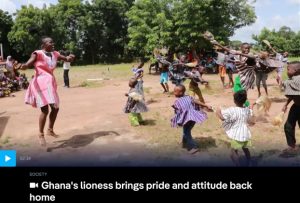
Watch the video: https://p.dw.com/p/3tLvW
When the broadcaster returned this year, it wasn’t to review a new album or measure streaming figures.
It wasn’t interested in awards, celebrity lifestyles or commercial success.
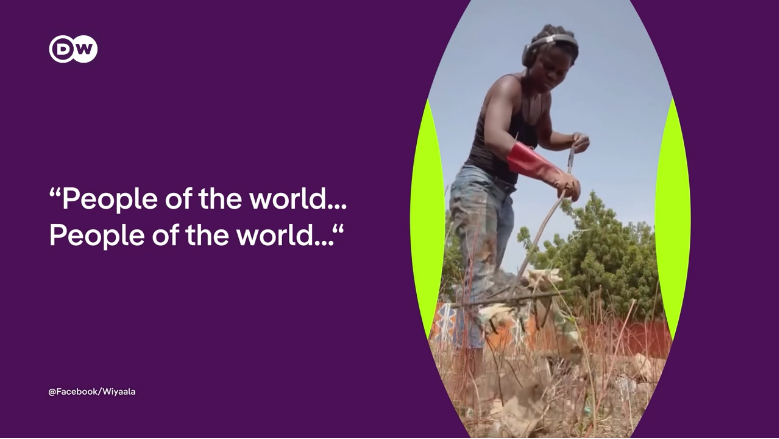
Instead, its cameras found Wiyaala carrying a rake through the streets of Funsi.
She stopped beside a pile of rubbish, began clearing it away and invited everyone watching to join her.
“If you care about rubbish, pick up a rake and join me. Don’t just stand there and pretend you didn’t see.”
There was no stage. No spotlight. No audience waiting for an encore.
Just someone prepared to lead by example.
That single image explains why DW came back.
Five years ago, the story was about a musician returning home.
Today, it is about what happened after she arrived.
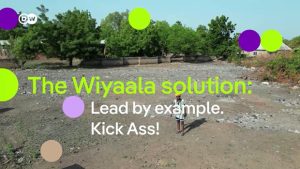
Watch the video: https://p.dw.com/p/5FfPT
“Five years later, DW returned to discover that the story had grown far beyond music.”
The contrast between the two documentaries is striking.
The first asked why someone with an international career would choose to return to a remote community.
The second asks a much bigger question.
Can success become a tool for building something that lasts beyond the individual? Watching the latest documentary, the answer begins to emerge.
Music has never been the destination. It became the vehicle.
Music enabled Wiyaala to travel across Africa, Europe, Australia and North America.
It introduced her to new ideas, new communities and different ways of thinking. But each journey ended in the same place. Back in Funsi.
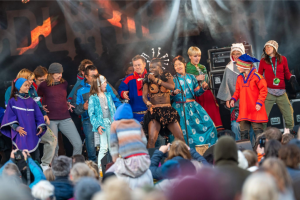
“Music took Wiyaala around the world. The lessons she learned kept bringing her back to Funsi.” (Photo: Ørjan Marakatt Bertelsen)
For years she has repeated the same message to audiences around the world: every journey teaches her something, and she returns home to see what can be applied to improve life in her own community.
The new DW documentary shows that this is more than a philosophy. It has become daily practice.
The Lioness Kingdom has grown into a centre where culture, education and community development meet.
Traditional music is being preserved. Young people are finding opportunities to perform and create.
Community radio is giving local voices a platform. Environmental campaigns encourage residents to take responsibility for their surroundings.
Visitors from around the world are discovering northern Ghana through its own traditions rather than through stereotypes. None of these initiatives appeared overnight.
Like the rake in Wiyaala’s hands, they began with someone deciding to start.
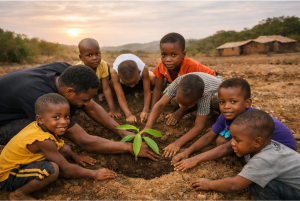
“The Lioness Kingdom continues to grow as a centre for culture, creativity and community development.”
Leadership by example is not glamorous.
It rarely makes headlines. Yet in an age of carefully managed online images, it may be one of the most persuasive forms of leadership there is.
That is perhaps the most important contribution of the two DW documentaries. The first introduced viewers to an extraordinary musician.
The second documents something even more significant. It records the gradual emergence of an idea. That success is not simply measured by what someone accumulates.
It can also be measured by what they help others create. People will always debate how success should be defined. Some measure it in awards, wealth and influence.
Others measure it by stronger communities, preserved cultures and opportunities created for future generations. Neither definition is entirely wrong. But they are measuring different things.
International broadcasters do not usually revisit stories unless those stories continue to evolve. DW’s return suggests that what is happening in Funsi has become larger than the career of one musician. It has become a story about culture, community and the possibilities that emerge when international success is invested back into the place where it began.
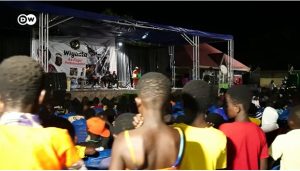
“Five years ago, DW documented a remarkable decision. Today, it is documenting the consequences of that decision.” (Photo: DW Screenshot)
Perhaps that is why this story is only just beginning.

